RI-01
Matthew McLaughlin
•
Introduction
Most rail-served industrial sites do not fail because they lack rail.
A community spends $15M extending rail into a new industrial park to spur industrial development. The ribbon is cut, marketing materials are prepared, and local leaders expect to land a major manufacturer bringing hundreds of jobs to the local economy.
Five years later, the site remains largely vacant. The problem was not the lack of rail; it was everything else.
Across North America, communities continue to invest millions of dollars in rail-served industrial parks, transload facilities, and freight rail infrastructure with the expectation that rail access attracts manufacturers, distribution centers, and logistics companies. Sometimes it works. More often, communities discover that rail access was only one piece of a much larger equation.
Over the past decade I have had the opportunity to evaluate industrial development opportunities from different perspectives: supporting freight railroads, collaborating with industrial developers, pursuing public infrastructure funding, evaluating commercial opportunities, and assisting customers with pivotal development decisions. Regardless of the project, I find myself returning to the same five topics.
I refer to these as the Five Pillars of Rail-Served Industrial Development. While these are not necessarily a rigid scoring model to determine if a location will be successful, they provide a practical framework for asking questions before significant capital is committed and spent.
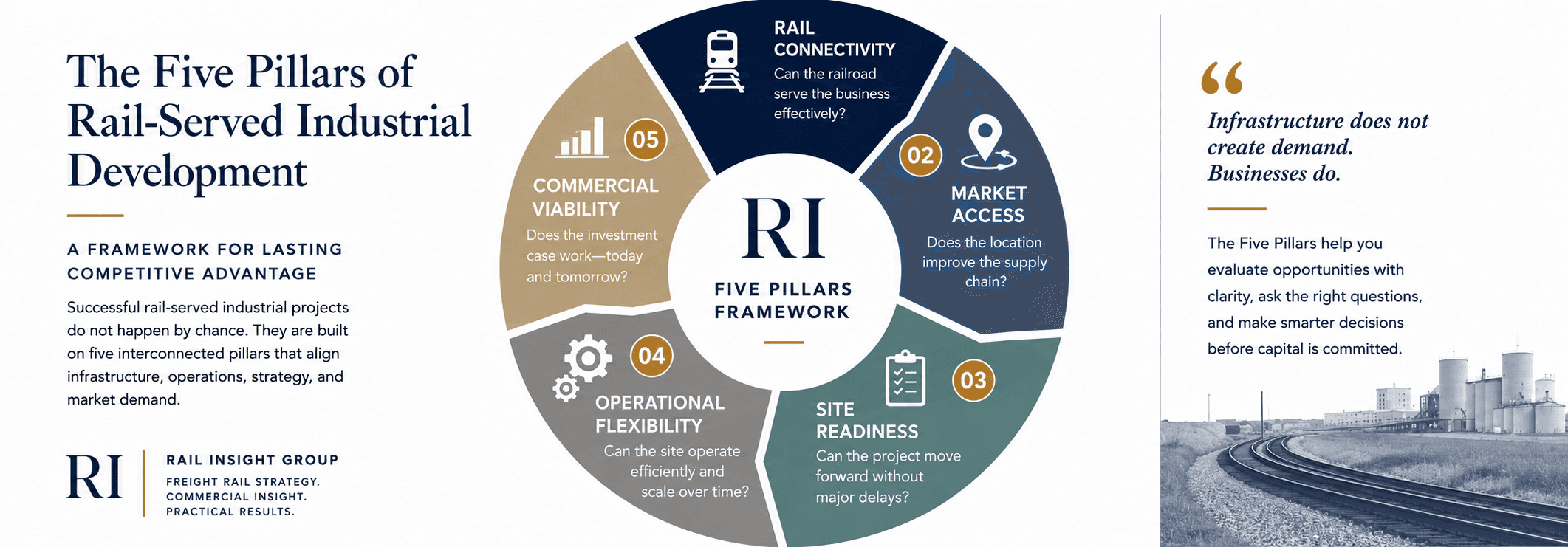
Pillar 1 – Rail Connectivity
Rail access is the starting point, not the finish line. One of the biggest misconceptions in industrial development is that property is automatically rail-served because track is nearby. Real estate agents and communities may advertise “rail access” despite no existing mainline connection onto a railroad. While it may be possible to tie into the adjacent railroad, it requires a business case, approval, permitting, large upfront investment, and a lengthy timeline even if both are at grade and it seems like a straightforward process.
Even if the property has an existing mainline connection, the quality of rail connectivity matters far more than its existence.
A site may require a new mainline switch, extensive track rehabilitation, or a completely different operating method than was used in prior operations. Switching frequency, ownership, interchange arrangements, and available capacity all influence whether rail creates a competitive advantage or becomes an operational constraint. Layer in the serving carrier and their desire for new, rail-served customers before getting too far down the track.
Rail Insight
Rail infrastructure creates potential.
Reliable rail service creates the opportunity.
Questions for Consideration
Is the railroad actively serving the property today? If so, what is the service?
What investment is required before service can begin?
Track rehab, reconfiguration, etc.
How frequently can the property be switched?
Does the railroad have capacity to support future growth?
Will rail improve the customer's supply chain or simply provide another transportation option?
Pillar 2 – Market Access
Some of the most attractive rail-served properties I have evaluated have never become successful industrial developments. They had rail access, available land, existing warehouse space, public incentives, and local support. On paper, they checked every box.
What they lacked was market access.
A well-positioned industrial site connects businesses with suppliers, customers, labor, and transportation networks. Even the best rail infrastructure cannot overcome a location that adds cost, increases transit time, or limits access to the workforce a company needs. Rail should strengthen a supply chain; not become the reason a company chooses a location.
When evaluating a potential development, I spend as much time looking beyond the property boundary as I do studying track layout. Understanding where a site sits within the broader regional economy is often more important than the rail infrastructure itself. Nearby manufacturers, distribution networks, interstate access, labor availability, and population growth frequently determine whether a project succeeds over the long term.
Rail Insight
Rail moves freight.
Markets move business.
Successful industrial sites require both.
Questions for Consideration
Is the site close to interstate highways? Airports?
Does the local labor market support the target industry?
Are suppliers and customers within an economical transportation radius?
Does the location create a competitive advantage over alternative sites?
Are there complementary industries or established industrial clusters nearby?
Pillar 3 – Site Readiness
Promising projects lose momentum long before construction begins. Utility upgrades, environmental permitting, site grading, railroad approvals, and local entitlements all introduce uncertainty that can delay a project by months or even years.
For prospective customers, time can be just as valuable as cost. A company facing production constraints or planning a new distribution network often cannot afford an extended development timeline. The sites that consistently outperform competing locations are those that minimize unknowns and allow projects to move from concept to construction with confidence.
Reducing uncertainty is one of the greatest competitive advantages a development site can offer. Class I Railroads, economic development organizations, and site selectors increasingly recognize this, investing significant effort into creating “shovel-ready” sites. Many landowners go beyond infrastructure by completing environmental studies, securing permits, identifying utility capacity, and even preparing conceptual facility layouts to demonstrate how a prospective customer could develop the property. The objective is not simply to have available land. It is to remove as many obstacles as possible before a customer begins evaluating the site.
Rail Insight
Time creates risk.
Every month removed from a development schedule increases project certainty and improves a site’s competitive position.
Questions for Consideration
Are electric, natural gas, water, wastewater, and/or telecommunications utilities available with sufficient capacity?
What railroad approvals are required? What is the anticipated timeline?
Are environmental or permitting issues resolved?
Greenfield or brownfield site?
Can construction begin immediately or are significant site improvements still needed?
Does the site allow room for future expansion as customer demand grows?
Pillar 4 – Operational Flexibility
A well-designed industrial site can become an operational bottleneck if day-to-day movements are not considered during the planning process. Efficient industrial development extends beyond track fitting onto a site. It requires designing a facility that allows railcars, trucks, employees, and equipment to operate safely and efficiently under a variety of operating conditions.
The most successful developments are designed with flexibility in mind. Rail service frequency, along with service windows, may change as business grows, the mix of truck or rail traffic may change, and production volumes rarely remain static. Providing adequate railcar storage, efficient truck circulation, and room for track expansion allows a facility to adapt without requiring costly redesign or disrupting ongoing operations.
Operational flexibility should reduce dependency on a single operating assumption. A facility should continue to function effectively whether it is switched daily, several times a week, or only as needed. Planning for these scenarios during site design is significantly less expensive than correcting operational constraints after construction.
The most successful industrial sites rarely look the same ten years after opening. Customers expand facilities, rail volumes increase, additional tracks are constructed, and truck traffic evolves. A site that cannot accommodate change often reaches its practical limits long before it reaches its commercial potential.
Rail Insight
Capacity is not just about how much a site can handle.
It is about how efficiently it can manage change.
Questions for Consideration
Can trucks, employees, and rail operations move safely without interfering with one another?
Is there sufficient railcar spotting and storage capacity for both current and future demand?
Can additional track, railcar storage, commodity storage, or loading areas be added as business grows?
Will railroad switching interrupt production, shipping, or truck movements?
Does the site layout support efficient operations during periods of peak activity?
Pillar 5 – Commercial Viability
Infrastructure does not create demand. Businesses do.
Every project should answer one question: does the commercial case justify investment?
Rail infrastructure, public funding, and tax incentives may improve project economics, but they cannot create sustainable demand where none exists. Successful developments begin with a clearly defined market opportunity, followed by investment in needed infrastructure to support it. The sequence matters.
This is particularly evident when developing new transload facilities. Many projects begin with the assumption that customers will materialize once infrastructure is in place. On rare occasions that may happen, but more often successful facilities are anchored by one or more committed customers whose business provides the foundation for future growth. Once that base is established, additional customers become significantly easier to attract.
Commercial viability requires understanding the customer’s economics. Rail provides measurable value through lower transportation costs, improved supply chain reliability, increased capacity, or access to new markets. If rail does not create a meaningful competitive advantage, the investment should be reconsidered, regardless of how attractive the infrastructure appears to be.
This does not necessarily mean that speculative development is never appropriate. There are successful industrial parks and transload facilities built in anticipation of future demand. However, even speculative investments should be grounded in market analysis, target industries, and realistic commercial assumptions rather than optimism alone.
Rail Insight
Customers justify infrastructure.
Infrastructure rarely creates customers.
Questions for Consideration
Is there sustainable customer demand for the proposed development?
Does rail provide measurable operational or economic advantage?
What freight volumes are required to justify the investment?
Would the project still make sense without grants?
How does this opportunity compare with competing rail-served locations?
Putting the Framework to Work
No industrial site will score perfectly across all Five Pillars, nor should that be the expectation. Every project will have tradeoffs, whether they relate to location, infrastructure, timing, capital investment, or market conditions. The objective of this framework is not to eliminate risk. It is to understand it before significant resources are committed.
The Five Pillars are intended to encourage meaningful conversations between railroads, developers, economic development organizations, site selectors, investors, and prospective customers. Evaluating each pillar early in the planning process allows stakeholders to identify weaknesses, prioritize investment, and make informed decisions before projects become constrained by sunk costs or unrealistic expectations.
Most projects do not fail because of a single catastrophic mistake. They fail because issues compound over time; a utility upgrade takes longer than expected, railroad approvals delay construction, market assumptions change, truck circulation becomes inefficient, a prospective customer fails to materialize, etc. Individually, each challenge may be manageable. Collectively, they can undermine an otherwise promising project.
Rail Insight
The goal is not to build a perfect industrial site.
The goal is to understand where risk exists before it becomes expensive.
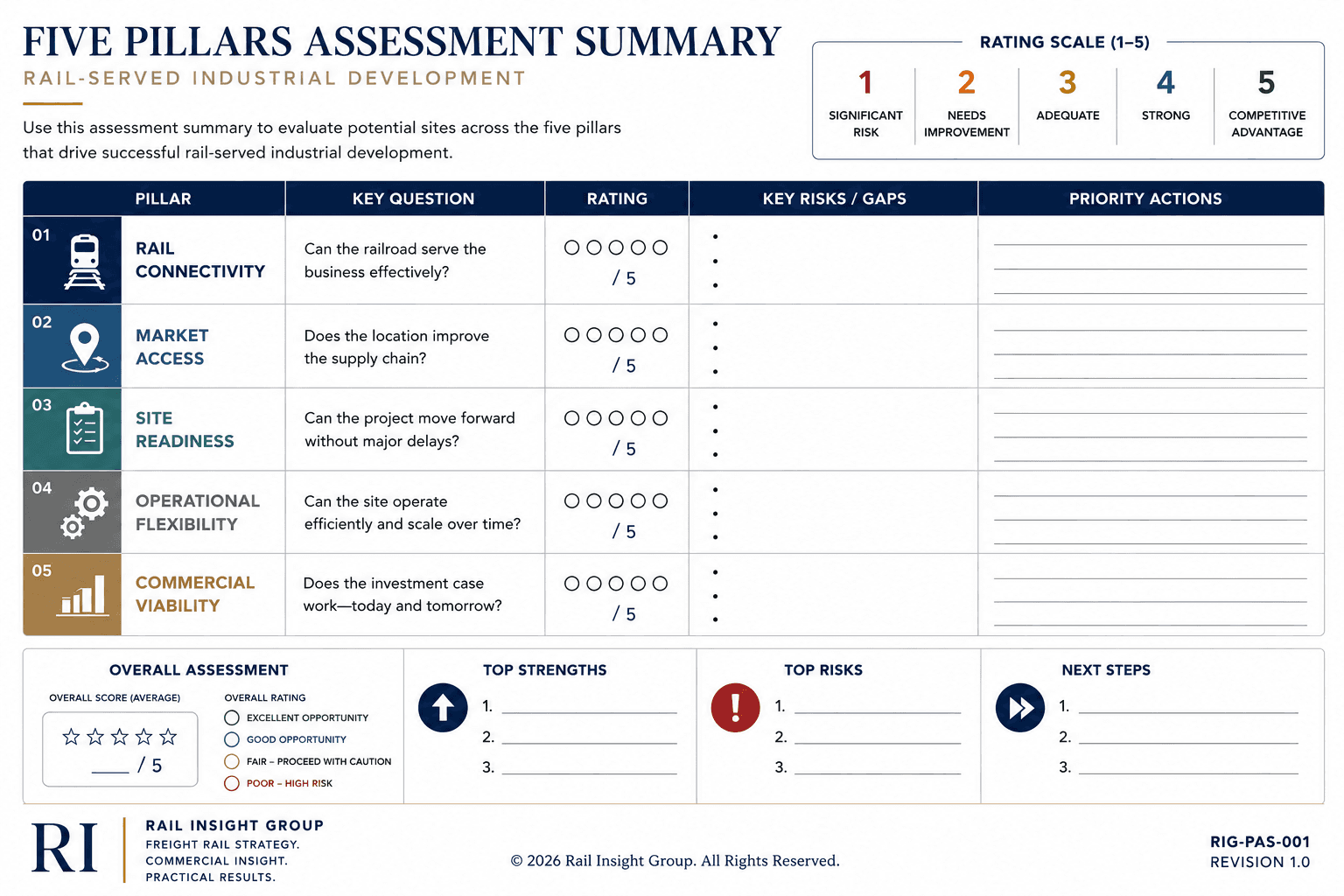
Final Thoughts
Rail-served industrial development is about far more than putting track next to available land. Successful projects balance infrastructure, market dynamics, operational requirements, and commercial realities to create locations where businesses can compete and grow over the long term.
The Five Pillars of Rail-Served Industrial Development are intended to provide a practical framework for evaluating opportunities before significant capital is committed. While no project will excel in every category, asking the right questions early helps identify risk, prioritize investment, and improve decision making for railroads, developers, economic development organizations, and private industry alike.
The most successful projects are rarely those with the most incentives or the newest infrastructure. They are the ones built around a clear understanding of customer needs, operational realities, and long-term commercial demand.
Rail Insight
Rail access creates opportunity.
Sound planning creates successful industrial development.
About Rail Insight Group
Rail Insight Group publishes the Rail Insight Series, a collection of practical perspectives on freight rail strategy, industrial development, rail-served site selection, commercial growth, and infrastructure investment. Each publication is designed to provide actionable frameworks and real-world insights that help railroads, businesses, developers, investors, and economic development organizations make better commercial decisions.
Learn more at railinsightgroup.com.
About Rail Insight Group
Rail Insight Group is an independent freight rail advisory firm serving railroads, rail-served industries, investors, and infrastructure stakeholders across North America.